Productivity has become one of the defining challenges for Australia’s economy.
From the Federal Government to state agencies, productivity is consistently identified as essential to improving economic performance, strengthening public services and ensuring taxpayer resources deliver greater value. Reports from Treasury, the Productivity Commission and government leaders all point to the same conclusion: improving productivity is critical to Australia’s future prosperity.
Yet while productivity is frequently discussed, far less attention is given to how organisations actually improve it.
Productivity is not achieved through policy statements or budget measures alone. It is built through better systems, better processes and better leadership. This is where Lean Thinking and Continuous Improvement become essential.
Productivity Is an Outcome, Not a Strategy
Productivity is often misunderstood as simply asking people to do more with less.
In reality, sustainable productivity is about enabling people to deliver better outcomes by improving the way work is done.
For government agencies, this means:
- reducing unnecessary administration
- simplifying complex processes
- removing duplication and rework
- improving decision making
- making better use of technology
- reducing delays in service delivery
- empowering employees to solve problems where they occur.
These are not new ideas. They are the foundations of Lean Thinking and Continuous Improvement.
While government commonly talks about productivity, industry has spent decades developing the practical disciplines needed to achieve it.
The Capability Behind Productivity
Across the private sector, organisations have long recognised that productivity improves when continuous improvement becomes part of everyday work.
Known by various names including Lean, Continuous Improvement, Operational Excellence and Business Improvement, these approaches all share a common purpose: delivering greater value with the resources available.
The language may differ, but the objective is the same.
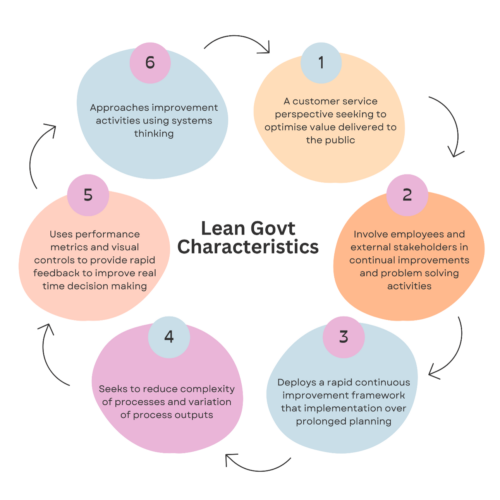
Lean provides organisations with a structured way to examine how work flows, identify barriers to performance and remove activities that do not create value.
Continuous Improvement creates the culture where employees continuously seek better ways of working rather than waiting for large-scale reform programs.
Together, they create organisational capability that delivers sustained productivity improvements.
Why Lean Thinking Matters in Government
Although Lean originated in manufacturing, it has evolved into a globally recognised management philosophy used across healthcare, education, defence, financial services and government.
In the public sector, Lean is not about producing products more efficiently. It is about delivering public services more effectively.
Lean helps government agencies improve processes such as:
- grant administration
- licensing and approvals
- procurement
- regulatory services
- customer contact centres
- planning and infrastructure approvals
- health and community services
- internal corporate functions.
By identifying unnecessary steps, reducing waiting times and improving process flow, agencies can deliver faster, more consistent services while making better use of public resources.
The result is improved service delivery, reduced operational costs and a better experience for citizens.
Continuous Improvement Creates Better Government
Many government improvement initiatives begin with significant reform programs. While these often generate positive outcomes, they can lose momentum once implementation is complete.
Continuous Improvement offers a different approach.
Rather than viewing productivity as a project, it becomes an organisational capability embedded in daily operations. Employees are encouraged to identify problems, improve processes and eliminate waste as part of their normal work. Leaders support this by creating an environment where learning, innovation and collaboration become everyday behaviours.
Over time, hundreds of small improvements accumulate into substantial gains in productivity, efficiency and service quality.
Leadership Is the Driver of Productivity
Technology, policy and funding all influence productivity. However, the greatest driver is leadership.
Leaders establish priorities, remove barriers, encourage innovation and create the conditions where improvement becomes everyone’s responsibility. When leaders adopt Lean Thinking, they move beyond managing activities to improving the systems that produce results.
This shift enables organisations to become more responsive, adaptable and resilient in an increasingly complex operating environment.
Building Productivity Capability Across Government
Australia’s productivity challenge cannot be solved through economic policy alone. It requires organisations that know how to improve the way work is performed.
Lean Thinking and Continuous Improvement provide that capability.
Rather than relying solely on periodic reform, government agencies can build the internal skills, systems and culture required to deliver ongoing improvements in efficiency, effectiveness and public value. As expectations on government continue to grow, so too does the need for practical approaches that translate productivity objectives into measurable outcomes.
The Opportunity Ahead
Government has rightly placed productivity at the centre of Australia’s economic conversation.
The next step is building the organisational capability required to deliver it.
Lean Thinking and Continuous Improvement are not simply improvement methodologies. They are practical leadership disciplines that enable government agencies to improve performance, strengthen service delivery and maximise the value of every public dollar.
If productivity is Australia’s destination, Lean provides one of the clearest pathways to getting there.
For government agencies seeking to improve service delivery while meeting growing community expectations, the question is no longer whether productivity matters.
The question is whether they have the capability to achieve it.
